The Problem: An Industry Still Quoting Like It's 2010
The U.S. junk removal industry generated an estimated $10.7 billion in revenue in a recent 12-month period, with roughly 68% of Americans having used a junk removal service at least once in the past five years. Demand is not the problem. Speed is — and once a job is booked, most haulers are still running the rest of the business the same disconnected way: a phone for leads, a notebook or spreadsheet for pricing, a group text for dispatch, and separate software (or none) for invoicing and payroll.
Most junk removal companies still require a phone call, a callback, or an in-person walkthrough before they'll commit to a price. In an industry where same-day service is now the expectation, that delay is where bookings are lost — not to a competitor with better trucks, but to whichever company responds first.
Industry-wide, technology adoption is already reshaping the cost structure of the business. Route optimization software alone has been shown to cut fleet mileage by as much as 25%, and landfill diversion through recycling and donation partnerships now exceeds 50% among organized operators. The tools exist. What's been missing is one platform that fixes the pricing problem and everything downstream of it — scheduling, dispatch, invoicing, payroll, and multi-location growth — instead of forcing haulers to stitch together five different tools.
What Junkscan Is
Junkscan is the SaaS platform junk removal companies run their entire business on — a single system covering AI-powered photo quoting, a lead pipeline, scheduling and dispatch, a driver app with dump-site ticket tracking, invoicing and payments, employee management and payroll, and multi-location tools. It's not a bundle of separate products glued together; it's one dashboard a hauler logs into, and every part of the job — from the moment a customer's photo comes in to the moment the invoice is paid — runs through it.
Junk Removal Club is the national directory where customers search for and find verified junk removal companies by city. It's the front door for discovery. Junkscan is what happens after — the software behind every listed hauler's business.
Instant AI Photo Quoting: Where Every Job Starts
The most visible feature inside Junkscan is instant AI photo quoting. A customer takes a photo of what they need hauled away — old furniture, construction debris, a garage full of junk after a move — and Junkscan returns a price estimate in seconds, not hours.
No callback. No waiting for a crew to swing by and eyeball the pile. No guessing whether the quote they get on the phone will match the price the truck shows up with.
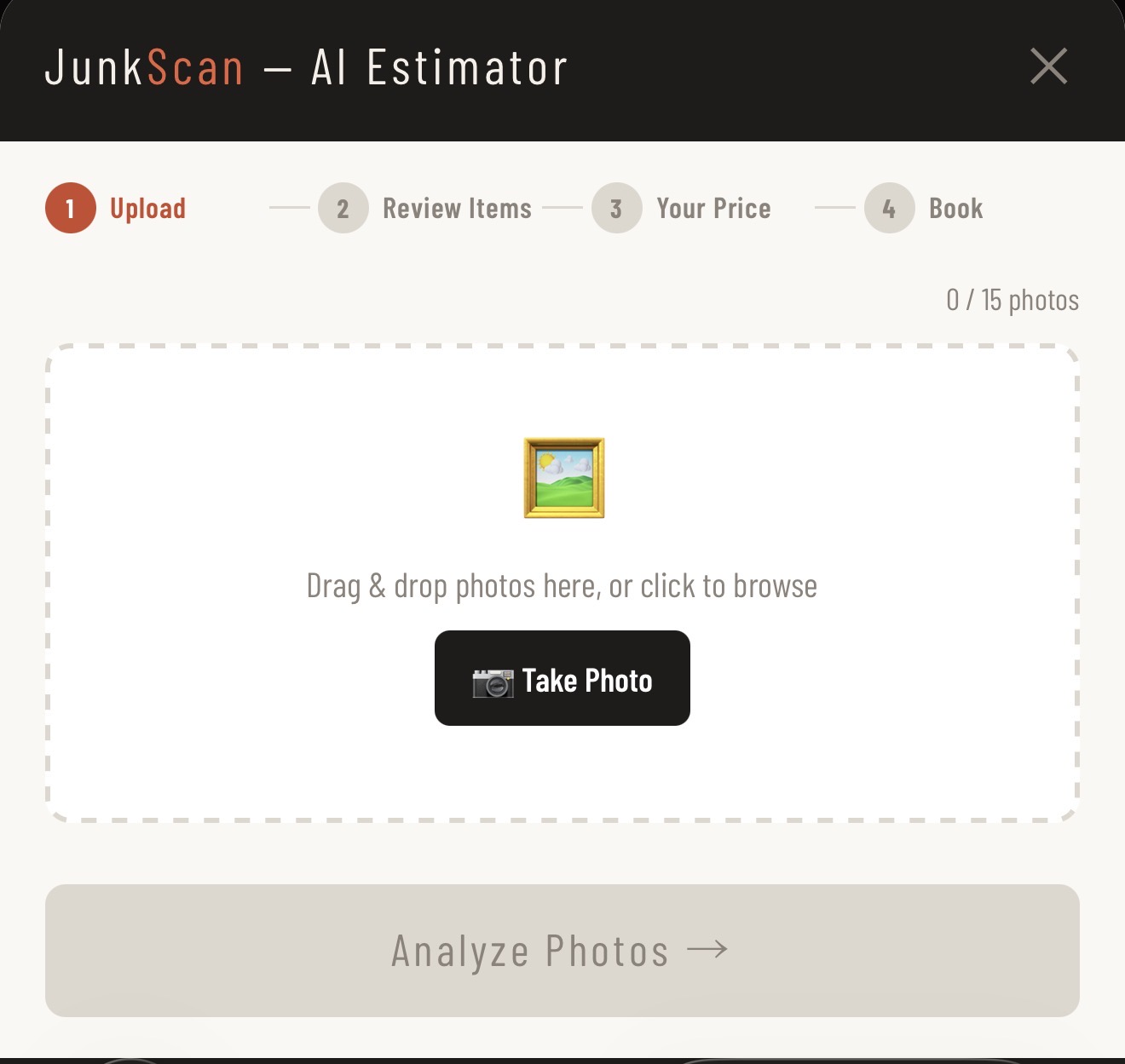
For the customer, that means:
- Instant price certainty before committing to book
- No scheduling a walkthrough just to find out what something costs
- A clear, upfront number instead of a vague phone-quote range that changes once the crew arrives
But AI photo quoting is a feature of Junkscan, not the product itself. It's the entry point — the moment a job enters the system — and everything that happens next runs on the same platform, not a separate tool.
Everything That Happens After the Quote
Once a photo estimate turns into a lead, everything that used to happen across a notebook, a group chat, a separate invoicing app, and a spreadsheet now happens inside Junkscan itself:
- Lead pipeline — every inquiry, callback, and follow-up tracked from first contact through completed, paid job, with automatic reminders so nothing gets lost in a text thread.
- Quotes & invoicing — the AI estimate carries straight through to a formal quote and, once the job is done, an invoice with built-in card payment collection — no re-typing the job into a second piece of software.
- Scheduling & dispatch — booked jobs move into a crew-facing workflow that assigns the right truck and team automatically, instead of a manager juggling it by phone.
- Driver app & dump-site tracking — dispatch always knows which truck and crew are on which job, and drivers use the same platform's mobile view to see their route, mark jobs complete, and log where a load was actually dumped — the ticket, with photo and weight, captured in the field.
- Employee management & driver payroll — roles, access, and pay are managed per employee, so a hauler can bring on crew and drivers without bolting on separate HR software.
- Multi-location growth — operators running more than one branch manage all locations from a single Junkscan account instead of running each one as a disconnected business.
- Reviews & reputation tools and recurring account management for commercial and property management clients who need standing service, not one-off jobs.

That's the shift this article is really about: the photo-quoting feature solved the most visible, most painful bottleneck first. But Junkscan itself is the full operating system underneath it — the one platform that carries a job all the way from "customer takes a photo" to "driver logs the dump ticket and the invoice is paid," without a hauler ever switching tools.
Why This Matters More at Scale
Junk Removal Club, the directory, isn't regional — it covers:
- 11,188 haulers
- 1,676 cities
- 1,069 counties
- All 50 states
- 3,382 disposal and donation facilities
That scale is what makes instant, consistent pricing possible in the first place. A quoting feature is only as good as the data behind it, and a national footprint means Junkscan's pricing logic is informed by real job data across markets — not a single city's averages applied everywhere else. The same scale advantage carries through to scheduling, dispatch, and dump-site tracking: the more jobs run through the platform, the better every hauler's operation gets.
It also means the combination of directory and SaaS can do something no regional player or generic field-service software can: show a customer real hauler availability, real local pricing patterns, and real disposal/donation routing, anywhere in the country, from one platform.
Solving the Industry's Real Software Problem
Most "junk removal software" on the market today isn't built for junk removal at all. Platforms like Workiz, Jobber, and Clarro are generic field-service tools — the same CRM, scheduling, and invoicing engine repackaged with different industry labels, whether that's HVAC, pet grooming, or hauling.
That works fine for generic scheduling. It does nothing for the actual pricing problem that makes junk removal unique: junk removal is priced by volume and visual assessment, not a flat service-call rate. None of the existing platforms have solved that with AI, and none of them are built around a junk hauler's actual workflow end-to-end — a dump-site ticket, a driver on a route, a recurring commercial account. Junkscan is built specifically around that gap, with AI-powered quoting as the entry point and full operational automation as the rest of the platform — not two separate products, one system.
The result is a single system built around how junk removal actually works, instead of a generic CRM with a junk removal label glued on top.
What This Means for Haulers
For the thousands of independent and small-crew haulers who make up the bulk of this industry, the economics are straightforward. Franchise-based operators — the segment with the most resources and technology — already average close to four completed jobs per vehicle per day, supported by standardized pricing and centralized systems. Independent haulers without access to that kind of infrastructure are competing at a structural disadvantage.
Junkscan exists to close that gap — giving any hauler listed on Junk Removal Club, regardless of size, the same instant-pricing and centralized, fully automated operations that only large franchises have historically had access to: one platform for quoting, dispatch, invoicing, driver management, and multi-location growth, instead of five disconnected tools and a notebook.
What This Means for Customers
The eco-conscious shift in this industry is real and growing — a large majority of customers now say they factor environmentally responsible disposal into which junk removal company they choose. Junk Removal Club's national facility network (3,382 locations) and Junkscan's hauler-level diversion tracking — captured directly from drivers' dump-site tickets in the field — are built directly around that expectation, giving customers visibility into where their junk actually ends up, not just who hauled it away.
Combined with instant AI pricing and a hauler operation that runs on one connected platform instead of a patchwork of tools, Junkscan is built around the things customers consistently say they want most from this kind of service: speed, transparency, and a company that shows up when it says it will.
Junk Removal Club is the national directory connecting customers with verified junk removal professionals in cities and counties across the United States. Junkscan is the SaaS platform those haulers run their business on. Try an instant photo quote free → See the full Junkscan platform →