Finding public-sector hauling work becomes easier when you stop treating government contracting as one market. Federal agencies, disaster programs, state and local buyers, and cooperative purchasing organizations use different rules and buying paths. The opportunity notice also tells you what kind of response is expected—sometimes a detailed proposal, sometimes a sealed price, and sometimes only a capability statement.
If you have not read the foundation, start with Part 1: The Foundation. This article focuses on recognizing the opportunity in front of you and choosing search codes that accurately describe your work.
The four tracks: where public-sector work comes from
1. Federal prime contracts and subcontracts
Federal departments, military installations, parks, hospitals, offices, and other facilities buy waste collection, cleanout, hauling, and facilities-related support. Prime contractors hold a direct contract with the agency. Subcontractors perform a defined portion for the prime.
Direct federal bidding generally requires an active SAM.gov entity registration and the representations required for that acquisition. Do not pay a third party merely to access SAM.gov; the federal registration itself is free. Search the official Contract Opportunities database and verify every notice and amendment there.
2. Disaster and emergency debris work
Disaster debris is not one national open contract. FEMA’s Public Assistance program may reimburse eligible state, local, tribal, territorial, and certain nonprofit applicants for eligible debris work after a presidential declaration. Those applicants procure contractors under applicable federal, state, local, and grant rules. USACE may also execute assigned emergency missions using pre-positioned contract tools and other authorities.
Review both FEMA’s debris-removal process and USACE Contracting in Disasters. A new hauler’s realistic path may be a local pre-event contract or subcontract rather than a national prime award.
3. State and local contracts
Cities, counties, school districts, housing authorities, public universities, transit agencies, and state departments run their own procurement systems. Many are approachable first contracts because the geography is limited and the scope may fit local equipment. There is no single national portal for all of them, so build a list of procurement pages for the public bodies in your actual service area.
Federal grant money can add federal requirements. The Uniform Guidance procurement standards in 2 CFR Part 200 may apply to a non-federal entity’s purchase, but the buyer’s solicitation remains your operational instruction.
4. Cooperative purchasing contracts
Cooperative purchasing organizations conduct a competitive solicitation that eligible public agencies may be able to use, subject to their own authority and policies. One awarded master agreement can therefore support purchases by multiple participating agencies. It is not a shortcut around competition for the supplier: winning the underlying cooperative solicitation can require broad coverage, strong pricing, reporting, and dealer or subcontractor networks.
Examples include Sourcewell, OMNIA Partners Public Sector, and NASPO ValuePoint. Read each program’s official supplier and solicitation information rather than assuming every public buyer can use every contract.
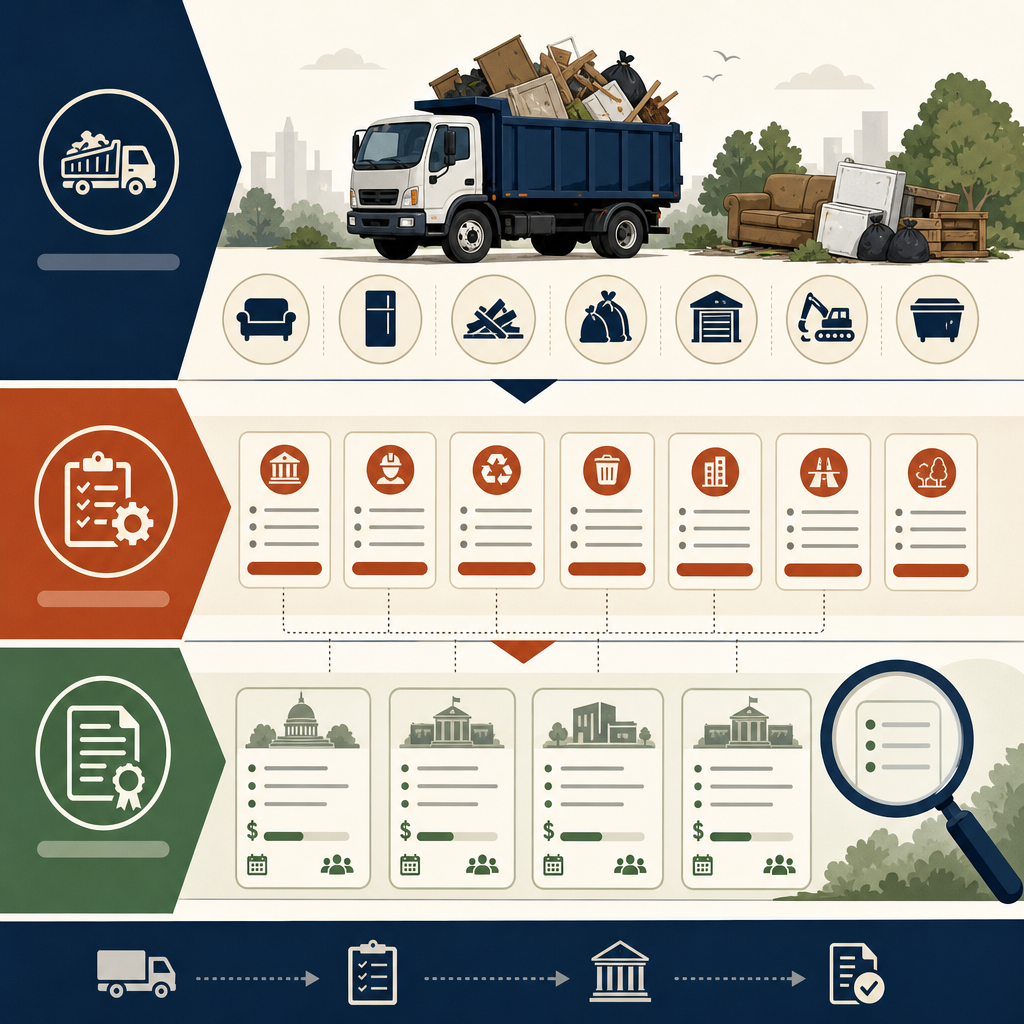
Types of notices and solicitations
Request for Proposal (RFP)
An RFP is used when the buyer will evaluate more than a price line. Technical approach, staffing, mobilization, quality control, past performance, and management can all matter. Federal negotiated procurements are generally addressed in FAR Part 15, but the solicitation’s instructions and evaluation factors control the response.
For a debris-management program or multi-year facility contract, expect a structured written submission. Build a compliance matrix before writing so every required section, attachment, and representation has an owner.
Invitation for Bid (IFB) or sealed bid
Sealed bidding emphasizes exact responsiveness to a defined specification and commonly awards to the lowest-priced responsible bidder whose bid conforms to the invitation. Federal sealed bidding is covered in FAR Part 14. State and local terminology varies.
Precision matters. A missing signature, acknowledgment, bid security item, or required form can make a low bid nonresponsive. Do not assume the buyer can let you repair a material omission after opening.
Request for Quotation (RFQ)
An RFQ often supports a streamlined purchase where the buyer wants price, availability, and confirmation that you can meet a defined requirement without a full technical proposal. The response burden may be lower than an RFP, making an accurately scoped RFQ a useful entry point. “RFQ” can also mean Request for Qualifications in some state and local systems, so read the title and instructions rather than relying on the acronym.
Request for Information (RFI) and Sources Sought
These are market-research notices, not awards you can win immediately. Agencies use them to learn which vendors are capable, whether small businesses can perform, and how a future requirement should be structured. A targeted response can introduce your company before the solicitation is final.
Answer the agency’s questions directly. Include relevant equipment, coverage, disposal relationships, mobilization time, safety systems, and comparable projects. Do not submit a generic sales brochure when the notice asks for specific capacity data.
Presolicitation, combined notices, and intended sole source
- Presolicitation notices provide advance warning and time to assess partners, equipment, insurance, and pricing.
- Combined synopsis/solicitations combine the public notice and live solicitation, often on a faster timeline.
- Notices of intent to sole source explain an agency’s planned noncompetitive award. If the notice invites capability responses and you can genuinely meet the requirement, follow its deadline and instructions precisely.
Choosing NAICS codes for hauling work
The North American Industry Classification System classifies the contractor’s industry. In federal contracting, the contracting officer assigns one NAICS code to the solicitation, and that code determines the applicable SBA size standard. Your SAM.gov profile may list multiple codes that truthfully describe the company, with one designated as primary.
Common codes to investigate include:
- 562111 — Solid Waste Collection: collection and hauling of nonhazardous solid waste.
- 562119 — Other Waste Collection: other nonhazardous waste collection, including brush or rubble collection examples in the official classification.
- 562112 — Hazardous Waste Collection: only when the company is legally equipped, licensed, and insured for hazardous-waste collection.
- 562910 — Remediation Services: environmental remediation and abatement work, which is not interchangeable with ordinary junk removal.
Use the U.S. Census Bureau NAICS search to read the official descriptions. Do not add hazardous-waste or remediation codes merely to receive more search results. A code must match work the company can legally and operationally perform.
Understanding SBA size standards
“Small” is not a general description of headcount. For federal contracting it is measured under the SBA standard attached to the solicitation’s NAICS code, including applicable affiliation rules. The current SBA table lists receipt-based standards for the waste-collection codes discussed above. At publication, the listed standard for NAICS 562111, 562112, and 562119 is $47 million in average annual receipts, while 562910 generally uses a $25 million receipts standard with an important footnote for certain environmental-remediation procurements.
Receipts-based standards generally use average annual receipts over the business’s five most recently completed fiscal years, with special rules for younger businesses. Because size rules and footnotes can change—and a proposed rule is not yet an effective rule—confirm the current SBA Table of Small Business Size Standards and 13 CFR Part 121 before certifying size.
Product Service Codes: what the agency is buying
NAICS and Product Service Codes are related but not interchangeable. NAICS describes the industry and controls the size standard. A PSC classifies the product or service purchased on a federal contract action.
For routine trash or garbage collection, PSC S205 — Housekeeping: Trash/Garbage Collection is an important search term. Adjacent work may appear under a different PSC depending on the principal purpose of the contract. Confirm descriptions in the official Product and Service Code Manual rather than building a search around an unofficial list.
Search SAM.gov with combinations:
- Your truthful NAICS codes.
- Relevant PSCs.
- Plain-language terms such as debris removal, waste collection, cleanout, hauling, bulk pickup, property preservation, and site clearance.
- Your service geography and realistic mobilization radius.
A disciplined next step
Create a simple opportunity watchlist rather than chasing every notice:
- Save federal searches in SAM.gov for accurate NAICS, PSC, and service terms.
- Bookmark procurement portals for the state, counties, cities, school districts, housing authorities, and public campuses you can serve.
- Register for vendor notifications only where the categories and geography fit.
- Respond selectively to Sources Sought notices with specific capability information.
- Run a bid/no-bid check for scope, deadline, insurance, equipment, disposal, cash flow, and past performance before writing.
Return to Part 1 for the readiness foundation, or explore more operating guidance in Junk Removal Club Resources.