Government agencies buy many of the same services junk removal and debris-hauling companies already provide: property cleanouts, illegal-dumping cleanup, bulk-item collection, facility turnover, storm debris removal, and hauling connected to repairs or demolition. The opportunity is real, but public-sector work is not simply a larger version of a residential job. It comes with formal instructions, eligibility rules, documentation, and contract terms that must be followed exactly.
This first article builds the foundation. It explains why public agencies hire haulers, what makes the market attractive, where first-time contractors commonly struggle, and why a small local company can still be a credible bidder. Part 2 explains the four purchasing tracks, solicitation types, NAICS codes, Product Service Codes, and size standards.
Why government agencies need junk removal and debris services
Public buyers do not always use the phrase “junk removal.” They may describe the same operational need as solid-waste collection, debris removal, property preservation, site clearance, hauling, facilities support, nuisance abatement, or bulk-waste pickup. Searching only for one consumer-facing phrase can hide much of the available work.
Recurring scenarios include:
- Housing and abandoned-property cleanouts. Housing authorities, land banks, code-enforcement departments, and public property managers may need units or lots cleared after the legally required process is complete.
- Illegal-dumping remediation. Public works, parks, transportation, and environmental departments often need labor, hauling, and disposal support for material left on public land.
- Facility renovation and turnover. Schools, courthouses, offices, military installations, and other public facilities generate furniture, fixtures, and construction-adjacent debris.
- Routine bulk-item and waste collection. Some cities, counties, campuses, and public authorities contract for recurring pickup rather than operating the entire service with public employees.
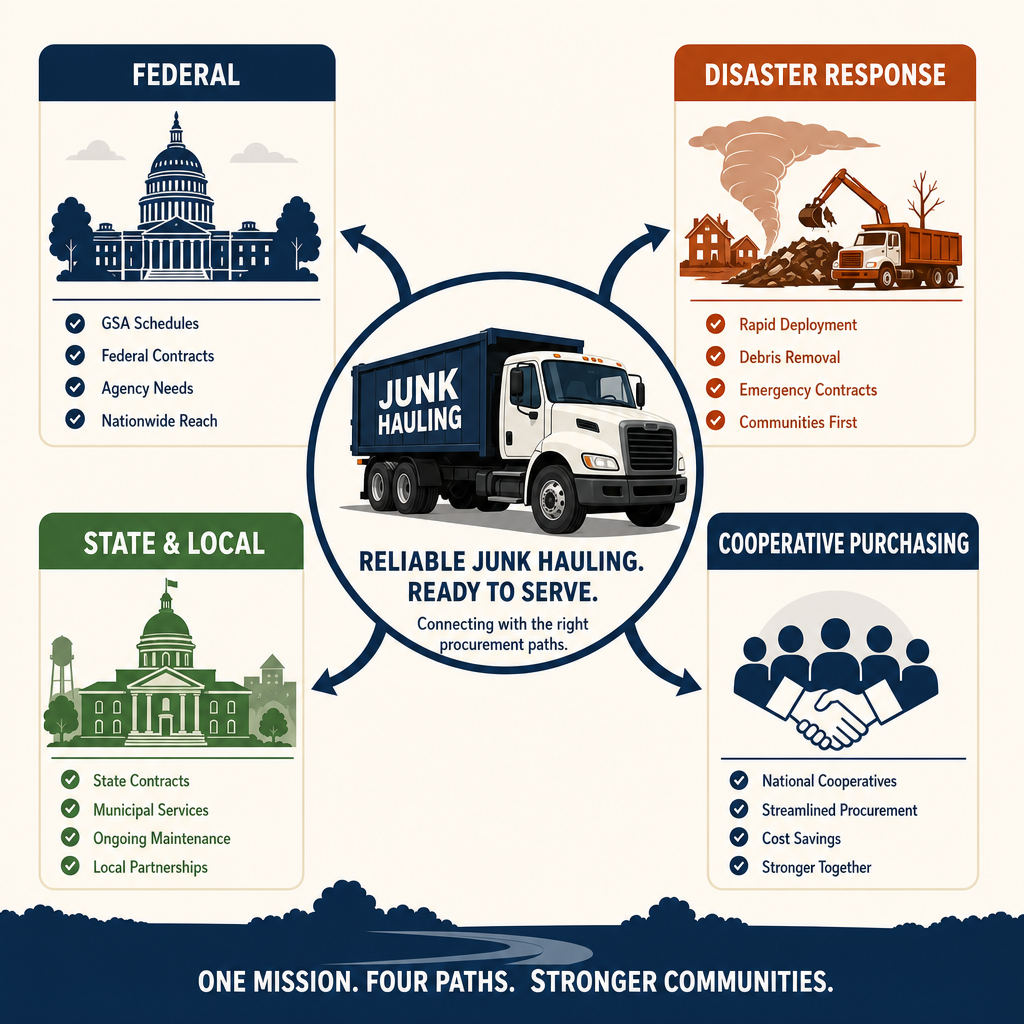
- Disaster debris work. Storms, fires, floods, and other emergencies can create urgent hauling demand. FEMA explains that eligible debris removal under its Public Assistance program is performed by state, local, tribal, territorial, and other eligible applicants, which may procure contractors under applicable rules. Review FEMA debris-removal guidance before treating disaster work as an ordinary cleanup job.
What makes public-sector work attractive
Government contracting can diversify a hauler’s customer mix and create opportunities larger or longer-lived than a single residential cleanout. It should not be described as guaranteed or recession-proof, but several characteristics make it worth learning:
- Small-business participation is a formal federal priority. Federal law sets a government-wide goal that at least 23% of eligible prime-contract dollars go to small businesses. The SBA reported that small businesses received about $179 billion, or nearly 28% of prime federal contract dollars, in fiscal year 2025. See the SBA’s FY2025 scorecard release.
- Some contracts recur. Waste collection, facilities support, and task-order arrangements may run for a base period with options, creating repeat work when performance and funding remain satisfactory.
- Payment rules are documented. Federal agencies are subject to prompt-payment requirements, but timing still depends on a proper invoice, acceptance, and the contract. State and local terms vary, so cash-flow planning remains essential.
- Local knowledge can matter. A local hauler may understand disposal facilities, travel times, seasonal constraints, and mobilization needs better than a distant bidder.
What makes government contracting difficult
The same structure that makes public procurement more predictable also makes it less forgiving. A strong price cannot rescue a response that ignores a mandatory form, arrives after the deadline, or fails to acknowledge an amendment.
- Compliance comes before persuasion. Instructions, representations, insurance limits, licenses, bonds, disposal requirements, and submission formats can be pass/fail.
- Sales cycles can be slow. Market research, budget approval, public notice, evaluation, award, protests, and notice to proceed may take much longer than a commercial estimate.
- Past performance matters. New contractors may need to start with smaller local work, subcontracting, or simplified purchases while building a documented performance record.
- Cash flow still matters. You may need to pay labor, tipping fees, fuel, equipment, and subcontractors before the agency pays an accepted invoice.
- Scope mistakes are expensive. Debris volume, contaminants, traffic control, monitoring, disposal destinations, documentation, and surge capacity can change the real cost dramatically.
You do not need to be a national company
Many first-time contractors assume every government opportunity belongs to a large corporation with a proposal department. That is not how the entire market works. Large, complex disaster-debris prime contracts do tend to favor experienced firms with deep equipment, bonding, and mobilization capacity. A new owner-operator should not build a plan around winning one of those awards immediately.
More realistic entry points include:
- Small city, county, school-district, housing-authority, and special-district purchases.
- Subcontracting to an established prime that needs local trucks, crews, staging, or disposal knowledge.
- Federal requests for quotations and other streamlined purchases that match your current capacity.
- Sources Sought and Requests for Information, which let you introduce your capabilities before an agency finalizes a solicitation.
- Set-aside opportunities for businesses that meet the applicable size and program requirements.
The SBA’s federal contracting guide is the right starting point for registration, eligibility, and contracting-assistance programs. Certifications can help when you genuinely qualify, but they do not replace operational capacity, compliant pricing, or a complete response.
A practical readiness check
Before spending hours on registrations and bid portals, make sure the business itself is ready to perform under a written contract:
- Your legal business name, tax records, licenses, insurance, and banking information are consistent.
- You can document truck and trailer capacity, crew availability, equipment, and geographic coverage.
- You know which disposal or recycling facilities can accept the likely material and what they charge.
- You can track job tickets, weights, photographs, labor, equipment hours, manifests, and invoices.
- You understand your working-capital limit and will not bid a scope that requires unsupported mobilization.
- You have a short capability statement that explains what you do, where you perform, and what makes the company credible.
If you need to benchmark how other operators describe their service areas and specialties, browse the Junk Removal Club directory. Your government capability statement should be more specific than a consumer listing, but the exercise helps clarify the services and geography you can defend.
How to use this series
This article is adapted from Junk Removal Club’s broader government-contracting guide, scheduled for release on September 7, 2026. The larger guide follows the process from foundational concepts through registration, opportunity research, proposal writing, performance, payment, and a first-90-days action plan.
For now, continue to Part 2: Finding Opportunities and Understanding Solicitations. It explains where work comes from, how RFPs differ from IFBs and RFQs, and how to use NAICS and PSC codes without treating them as interchangeable.